
Survey Call Explained: How Telephone Surveys Improve Data Accuracy and Response Rates
In an era dominated by digital communication, collecting accurate and representative data is more challenging than ever. While online methods offer speed, the average survey response rate across all channels is just 33%, with many digital-only campaigns falling far short of that mark. This often leads to incomplete data, misunderstood questions, and significant nonresponse bias. Enter the survey call a proven methodology that leverages human interaction and strategic technology to overcome these limitations.
This article explains what a survey call is, details its structured process, and explores how telephone surveys consistently deliver higher data quality and stronger response rates. We will uncover why this method remains a cornerstone of reliable research for businesses, pollsters, and public institutions alike.
What Is a Survey Call?
A survey call is a research method where data is collected from respondents through a structured telephone interview. Unlike passive, self-administered questionnaires, a phone survey is an active, guided process. An interviewer, either a live, trained agent or a sophisticated automated system, follows a predefined script to ask questions and record answers in real time. This direct telephone contact is fundamental to its effectiveness.
These calls can be conducted by live agents using advanced survey software or through automated technologies like interactive voice response (IVR), which uses pre-recorded prompts and allows respondents to answer via their keypad or voice.
Survey calls are the preferred method for a wide range of applications, including:
- Market research and product feedback
- Customer satisfaction surveys and loyalty studies
- In-depth demographic and behavioral research
- Public opinion and political polling
- Healthcare and insurance experience assessments
- B2B research targeting specific decision-makers
The core advantage of a survey call lies in its interactive nature. It allows for immediate clarification, builds rapport, and ensures that the collected data is both complete and accurate, providing a depth of insight that is difficult to achieve through other means.
How Survey Calls Work
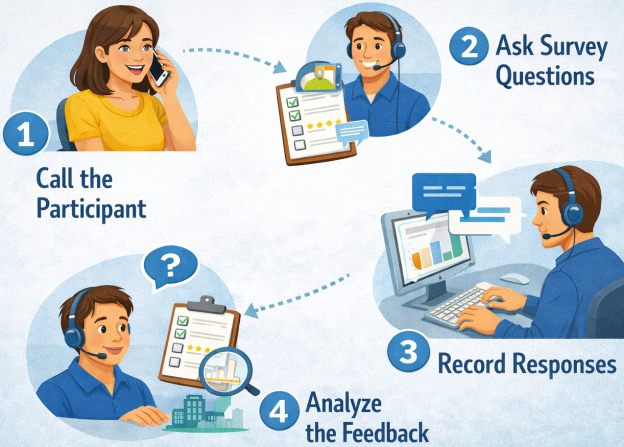
Survey calls follow a structured research process designed to maximize data quality, ensure consistency, and minimize bias from start to finish.
Survey Design
The process starts with the meticulous design of survey questions. For a phone survey, questions must be clear, neutral, and easy to comprehend when heard, not read. This involves avoiding complex jargon, double-barreled questions, or long lists of response options that can confuse respondents during a live conversation. The questionnaire is structured to create a natural conversational flow, keeping participants engaged from beginning to end.
Target Audience Selection
Researchers define the target population and select a representative sample to ensure the findings are generalizable. Methodologies for building a contact list vary. For broad population studies, researchers may use a random digit dial (RDD) system to generate numbers, ensuring that even unlisted numbers are included. For more targeted studies, they might utilize a telephone directory or a curated list, such as an internal voter file or customer database. The goal is to reach the right telephone household or individual to gather relevant demographic characteristics and opinions.
Interviewer Training
For studies using live agents, interviewer training is paramount. A well-trained interviewer is taught to be more than just a script-reader. Training focuses on:
- Reading questions exactly as written to ensure standardization.
- Maintaining a neutral, professional tone to avoid influencing answers and reduce response bias.
- Employing active listening to understand respondent feedback accurately.
- Probing for clarification on ambiguous answers without leading the respondent.
- Professionally managing refusals and navigating sensitive topics.
This rigorous training ensures every interview is conducted consistently, which is critical for maintaining the integrity of the collected data.
Call Execution and Data Capture
During the call, interviewers capture responses immediately using Computer-Assisted Telephone Interviewing (CATI) systems. This specialized survey software presents the interviewer with the script and allows for real-time data entry. This process virtually eliminates transcription errors and standardizes data collection, ensuring that the demographic data and answers are recorded accurately from the moment they are given.
Quality Control
To maintain high standards, most research firms implement strict quality control measures. Calls are often monitored live by supervisors or recorded for later review. Interviewers may be evaluated using performance scorecards that track their adherence to the script, tone of voice, and data entry accuracy. These protocols ensure that survey standards and ethical guidelines are consistently met.
Real-Time Clarification
One of the most significant advantages of survey calls is the ability to provide instant clarification. If a respondent is unsure about a question’s meaning, the interviewer can explain it in a neutral, pre-approved manner. This dynamic interaction prevents misinterpretation, a common pitfall in text-based surveys, and dramatically improves the accuracy of the final data.
Reduced Guessing and Skipping
In self-administered online surveys, respondents often guess at answers or skip questions they find confusing or difficult. The presence of a live interviewer in a survey call discourages this behavior. The interviewer can gently encourage a thoughtful response, rephrase a definition if needed, and ensure all critical questions are answered, leading to more complete and reliable datasets.
Consistent Question Delivery
Standardization is the bedrock of valid research. In a phone survey, trained interviewers deliver each question with the same wording, tone, and cadence to every participant. Automated systems using interactive voice response (IVR) take this consistency even further, delivering perfectly uniform audio prompts every time. This standardization is essential for producing comparable data that can be analyzed statistically.

Better Handling of Complex Topics
Survey calls excel when dealing with complex or nuanced subjects. Whether discussing intricate healthcare plans, detailed financial products, or B2B purchasing decisions, a live interviewer can guide respondents through complicated survey questions step-by-step. This prevents participants from feeling overwhelmed and enables the collection of detailed, high-quality information that would be nearly impossible to gather with a static form.
Human Engagement
A friendly, professional human voice can significantly increase survey participation. When respondents feel they are engaged in a real conversation with someone who values their opinion, they are more likely to invest their time and provide thoughtful answers. This human element builds rapport and accountability, fostering a positive participant experience that boosts completion rates.
Call-Back Strategies
Unlike a single email invitation, a phone survey campaign incorporates sophisticated callback strategies. Researchers know that not every call will be answered on the first try. A strategy of multiple call attempts at different times of day and on different days of the week is standard practice. This persistence is crucial for making successful telephone contact. When encountering an answering machine or voicemail, interviewers can leave a professional message explaining the purpose of the call, which can increase the likelihood of a future connection. These call retries are a key driver of higher survey response rates.
Reaching Hard-to-Access Populations
Telephone surveys are exceptionally effective at reaching populations that are often underrepresented in online research, thereby reducing nonresponse bias. This includes older adults, residents of rural areas, and individuals with limited or no internet access. By including these groups, a phone survey can produce a more accurate sample of the entire population. While overall response rates can be challenging, for instance, the median telephone response rate for certain Medicare Advantage surveys was 2.9% in 2025. The ability to reach these specific demographics is invaluable for creating a truly representative dataset.
read more : https://pedrovazpaulo.net
Shorter, Guided Experience
Because a skilled interviewer controls the pace and flow of the conversation, a telephone survey often feels shorter and more focused to the respondent. The interviewer guides them seamlessly from one question to the next, minimizing friction and reducing the likelihood of survey fatigue or abandonment. This guided experience respects the participant’s time and contributes to higher completion rates.
Survey Calls vs Online Surveys
While both telephone and online surveys are valuable tools, they are suited for different research objectives. The choice between them often involves a trade-off between cost, speed, and data quality.
| Factor | Survey Calls | Online Surveys |
| Data Accuracy | High.Real-time clarification and interviewer guidance minimize misinterpretation and reduceresponse bias. | Variable.Prone to misunderstood questions, guessing, and skipped items without direct oversight. |
| Response Rates | Generally higherfor targeted and hard-to-reach audiences due to personal contact and persistent follow-up strategies. | Often lower,especially without significant incentives. Can suffer from high abandonment rates. |
| Engagement | Strong.Human interaction builds rapport and encourages thoughtful, complete answers. | Limited.A passive experience that can feel impersonal, leading to rushed or disengaged responses. |
| Reach | Excellentfor reaching diverse populations, including those without aninternet connection. | Limitedto online populations, potentially introducing significantnonresponse bias. |
| Cost | Higheron a per-response basis due to labor and technology costs. | Lowercost at scale, making it ideal for large-sample, simple surveys. |
| Best For | Complex topics, sensitive questions, B2B research, and any project where data accuracy is the top priority. | Large-scale data collection, simple questionnaires, and situations where speed and budget are the primary constraints. |
Many modern research projects use a hybrid approach, initiating contact with an online survey and using follow-up survey calls to engage non-respondents or gather more detailed qualitative feedback.
Common Use Cases for Survey Calls
Survey calls are indispensable in scenarios where accuracy, depth, and representative sampling are non-negotiable. Key applications include:
- Public Opinion and Political Polling: Organizations like the Pew Research Center rely heavily on telephone polls to gauge public sentiment on political issues. By using methods like RDD to reach a representative sample of landline and cell phone numbers, they can collect data on political attitudes, party affiliation, and voting information to create a reliable snapshot of the electorate.
- Customer Satisfaction and CRM: Businesses use phone surveys to gather in-depth feedback on customer experiences. This data can be integrated directly into a Customer Relationship Management (CRM) system to inform service improvements and business strategy.
- Government and Public Sector Research: Agencies like the Australian Bureau of Statistics use household telephone surveys for critical data collection, such as their “Household Use of Information Technology” survey, which helps shape national policy.
- Market Research: Companies use survey calls to test new concepts, understand brand perception, and conduct pricing studies where explaining complex value propositions is necessary.
- Healthcare Feedback: Survey calls are used to collect sensitive patient feedback on care quality, helping hospitals and insurers improve services while maintaining patient confidentiality.
Are Survey Calls Still Relevant Today?
Absolutely. In an age of information overload and declining trust, the need for high-quality, verifiable data has never been greater. While digital tools have their place, survey calls remain uniquely relevant for their ability to mitigate common research flaws.
They directly combat nonresponse bias by reaching a broader cross-section of the population, including those outside the digital bubble. They enhance data quality through direct human oversight, clarification, and engagement. As research methodologies evolve, so does the technology behind survey calls. The rise of Voice AI and advanced speech input technologies is making automated phone surveys more conversational and effective, further blending technological efficiency with a human-like experience. For any organization that prioritizes the quality of its insights over the sheer quantity of responses, the survey call remains a powerful and essential research tool.
Conclusion
Survey calls are not an outdated methodology; they are a strategic instrument for high-stakes research. By artfully combining a structured process, advanced survey software, and the irreplaceable element of human interaction, telephone surveys deliver superior data accuracy, boost survey participation, and yield deeper insights than most self-administered methods.
While online surveys offer undeniable advantages in speed and scale, survey calls provide the clarity, verification, and engagement necessary for building a foundation of trustworthy data. In a world driven by data, the quality of that data determines the quality of the decisions made. For this reason, the survey call will continue to be a vital and indispensable part of modern research strategy.
✅ Meta Title (50–60 characters)
Survey Call Explained: Improving Accuracy & Response Rates
Character count: 57
✅ Meta Description (150–160 characters)
Understand what a survey call is and how telephone surveys improve data accuracy, reduce bias, and increase response rates compared to online surveys.
Character count: 158
✅ Best URL Slug
survey-call-explained-telephone-surveys
Keywords: Telephone Surveys – 420 Volume
Survey Design – 2000 Volume
Target Audience Selection – 20 Volume
Interviewer Training – 1,400 Volume