Organic vs. Conventional Lion’s Mane Extract: What’s the Real Difference for Buyers?
With the ascendant popularity of functional mushroom ingredients in the nutraceutical and wellness industries, the questions surrounding ingredient selection have become increasingly complex.
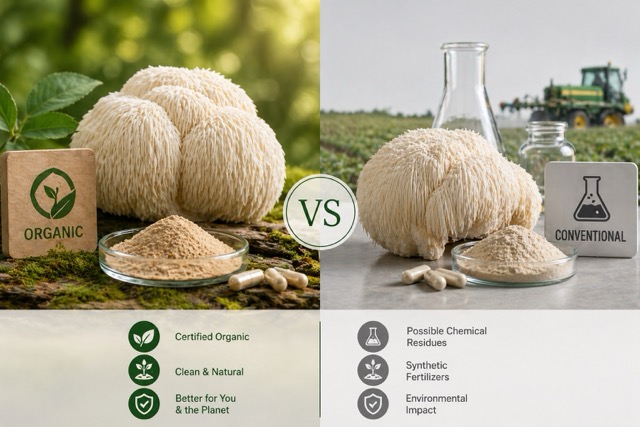
In most B2B buyer evaluations of lion’s mane mushroom extract, the organic versus conventional debate is not reduced to either/or generalizations. It is foremost a question of sourcing model, regulatory alignment, and market-oriented supply chain strategy, with claims to quality following the strategic choices.
Retail supplement developers or mass-market producers, large and small, first weigh price performance, certification choice, residue profile, and consumer marketing sequence when deciding on an ingredient specification. Functional quality features in a comparison of conventional or organic lion’s mane extract could have far-reaching and strategic consequences for both product performance and commercial performance.
Core Differences at a Glance
While both organic and conventional extracts can meet formulation needs, their characteristics often align with different business models.
| Factor | Organic Lion’s Mane Extract | Conventional Lion’s Mane Extract |
| Cultivation Method | Certified organic farming | Standard commercial cultivation |
| Synthetic Inputs | Restricted | May be used depending on the producer |
| Certification Potential | USDA Organic, EU Organic | Typically non-organic certifications |
| Traceability | Often stronger | Supplier-dependent |
| Cost | Higher | Lower |
| Common Market Position | Premium products | Value-driven products |
This comparison shows why sourcing decisions often depend on application goals rather than one ingredient category being universally preferable.
Raw Material Sourcing and Cultivation Standards
The first divergence comes during farming. Hericium erinaceus extract made from organic cultivation mostly comes from organic-certified areas, meaning synthetic pesticides or chemical fertilizers are banned, as well as there being compliance with other organic practices such as examination of the quality of the used substrate, environmental control, and recordkeeping.
Sometimes, an extract can be made from normal, traditional cultivation of certain raw materials as well, especially when large quantities are required. Here, the practice needs to be looked at on a case-by-case basis, as practices would differ widely between different suppliers and collection regions.
For the purchaser looking to buy the extract, most of the questions will not just be about how the raw material has been grown, but also about the reliability of supply, compliance, consistency, and various other questions.
Residue Risk and Quality Control
Residue risk remains a major purchasing consideration, especially as buyers face increasing scrutiny over contaminant testing.
| Quality Risk Factor | Organic Extract | Conventional Extract |
| Pesticide Residue Risk | Generally lower | Requires closer screening |
| Heavy Metal Exposure | Testing still essential | Testing still essential |
| Documentation Burden | Often higher | Supplier-dependent |
| Analytical Testing Expectations | High | High |
| Traceability Controls | Often stronger | Variable |
Organic regulations may alleviate certain safety concerns, but “organic” is not synonymous with being a replacement for legitimate testing. Discerning purchasers sometimes place an emphasis on certificates of analysis, metals testing, microbial limits, and active constituents quantification above all else, no matter the category.
In some cases, procurement departments that are tasked with identifying the highest quality bulk ingredients may assess alternative suppliers selling organic lion’s mane extract as one of the many prongs of their analysis and risk assessment.
Certification and Compliance Value
Certification can be one of the most explicit market differentiators.
USDA organic and EU organic certifications, for example, can help prove out anti-competitive label claims, ease retailer adoption, or open up international markets. For a product line catering to the clean-label consumer, that certification can be one of many ways to secure a reputational advantage.
In this case, the same conventional lion’s mane mushroom extract might still meet strong general quality metrics, i.e., GMP or ISO certifications, but since it lacks an organic badge, it might not help a brand connect with that later-established positioning.
For many B2B buying decisions, certification is not just a signal of quality. It’s a path to the market.
Consumer Perception and Market Demand
Consumer perception helps shape sourcing choices, too. In future years, the appeal of organic ingredients will remain robust in premium wellness-oriented product categories, as many consumers will still equate organic claims with purity, sustainability, and trust.
Such a perception can influence finished product pricing and market positioning.
In contrast, conventional extracts are the rule in mass-market and value-positioned product categories, particularly in cases when lower-income consumers are less motivated to seek out products based on certification claims.
This typically involves a parallel segmentation strategy: organic for narrow-channel product introductions and opportunities and conventional extracts for widespread retail market coverage.
Price Differences and Cost-Performance
Price remains a top decision point.
Organic plant extracts tend to be more expensive. Certification costs, along with more stringent agricultural practices and less commonly needed raw materials, all contribute. However, for many buyers, the real question isn’t absolute price; it’s price vs. the buyer’s other challenges and opportunities.
| Commercial Factor | Organic Extract | Conventional Extract |
| Ingredient Cost | Higher | Lower |
| Premium Pricing Support | Strong | Moderate |
| Margin Potential in Premium SKUs | Higher | Variable |
| Value for High-Volume Products | Moderate | Strong |
| Cost Efficiency | Lower | Higher |
If the end products will retail at the higher end of the market pricing structure, the added ingredient expense may be more than recoverable in final goods pricing. If the target application is a mass appeal line, the typical conventional Hericium erinaceus extract may overall provide better financial results.
Price points aside, the question rarely boils down to ingredient cost. It’s a question of cost-performance.
Application Scenarios
Different ingredient strategies suit different applications.
| Application Scenario | Typical Fit |
| Premium nootropic supplements | Organic |
| Clean-label wellness products | Organic |
| Specialty mushroom blends | Organic |
| Bulk private label formulations | Conventional |
| Functional beverage systems | Conventional |
| Mainstream supplement products | Conventional |
This is the type of calculation that often gets made around the sourcing of the point of difference. High-end capsules aimed at specialist retail may well warrant the investment in certified organic underpinning, whereas a line built on higher throughput may call for the efficiencies that conventional production can deliver.
It is not a test of worth per se. Rather, which commercial master are you serving?
What Buyers Should Compare Beyond Organic Claims
Experienced procurement professionals don’t assess the quality of botanical ingredients simply based on whether they are organic or conventional.
Decisions to purchase raw materials or finished products are made after additional evaluation of the following specifications:
- Ratio of botanical material to finished botanical ingredient; levels of active marker components
- Standardization of beta-glucans
- Sourcing of substrates (if fermentation is utilized) and more
- Condition of the third-party testing performed
- Acceptance of organic certification in the country of sale
- Consistency of supply
- Valuation of competitive pricing vs. quotations of potency
In the majority of cases, other factors have a greater impact on the success of a specific formulation or application than the organic versus conventional argument.
Final Assessment
The tradeoffs between organic and conventional lion’s mane mushroom extract for B2B buyers are seldom so clear-cut.
Organic options wield branding appeal, qualitative cachet, and access credentials for a number of the better-end applications and clean-label channels. Conventional extracts have a slew of other assets, like cost and scale efficiency, and a more reasonable supply chain equation for volume-market products.
The answer to sourcing isn’t about one being universally superior; it’s about where one’s markets are and at what price, how much risk one’s production tolerates. And how to put the attributes of lion’s mane to best use.
In that sense, the comparison is not organic versus conventional as such; the comparison is premium versus commodity, and which is more relevant for the end product.