
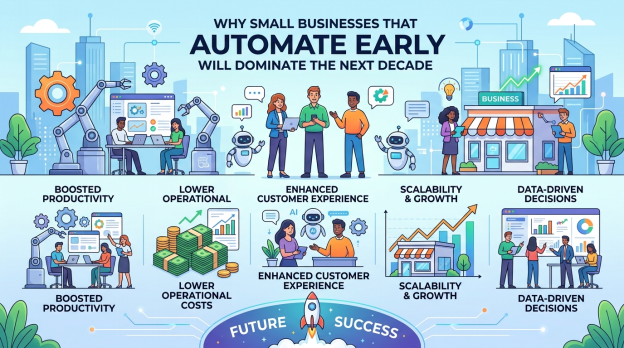
Why Small Businesses That Automate Early Will Dominate the Next Decade
For years, automation was viewed as something reserved for large corporations with massive budgets and enterprise-level infrastructure. Today, that perception has completely changed. In 2026, automation has become one of the most powerful competitive advantages available to small businesses.
From customer support and marketing to operations and data management, automation is transforming how businesses operate, scale, and compete in modern markets. Small businesses that embrace automation early are positioning themselves to move faster, reduce operational costs, improve customer experiences, and adapt more efficiently to future economic changes.
Meanwhile, businesses that resist automation risk falling behind competitors that can deliver services more efficiently, make smarter decisions, and operate with significantly less friction.
The next decade will not simply reward the biggest businesses. It will reward the most adaptable ones.
Automation Is No Longer Optional
The digital economy has changed customer expectations dramatically. Consumers now expect:
- Faster responses
- Personalized experiences
- Seamless online interactions
- 24/7 availability
- Efficient service delivery
Meeting these expectations manually is becoming increasingly difficult for small businesses with limited staff and resources.
Automation allows companies to streamline repetitive processes while improving speed and consistency. Instead of spending hours on administrative work, businesses can redirect time and energy toward growth, innovation, and customer relationships.
Tasks commonly automated today include:
- Email marketing
- Appointment scheduling
- Invoice generation
- Customer service chat support
- Lead nurturing
- Inventory management
- Social media posting
- Payroll processing
- Data reporting
Even service-based industries are using automation to improve scheduling, maintenance reminders, and customer communication. For example, HVAC companies offering ac maintenance houston tx services can automate appointment confirmations, recurring maintenance reminders, and customer follow-ups to improve retention and operational efficiency.
What once required entire teams can now often be handled through intelligent software and integrated systems.
Early Adopters Gain Long-Term Advantages
One of the biggest reasons early automation adopters will dominate the next decade is the compounding advantage automation creates over time.
Businesses that automate early begin collecting valuable operational data sooner. They identify inefficiencies faster, optimize workflows earlier, and create systems that continue improving as the company grows.
This creates a snowball effect.
For example:
- Faster workflows increase productivity
- Increased productivity improves customer satisfaction
- Better customer experiences improve retention
- Higher retention increases profitability
- Increased profitability allows more investment into automation and growth
Over time, these incremental advantages create significant separation between businesses that automate and those that rely heavily on manual operations.
In many industries, automation is becoming similar to internet adoption in the early 2000s. Businesses that embraced digital tools early gained enormous competitive advantages, while late adopters struggled to catch up.
The same pattern is now happening with automation and AI-driven business systems.
Small Businesses Can Scale Faster With Fewer Resources
One of the greatest challenges small businesses face is limited manpower. Hiring, training, and managing employees requires substantial time and financial investment.
Automation helps solve this problem by allowing small teams to operate more efficiently.
A small business using automated systems can often compete with much larger companies because:
- Tasks are completed faster
- Human error is reduced
- Customer communication improves
- Administrative workload decreases
- Operations become more organized
This efficiency allows businesses to scale without proportionally increasing labor costs.
For example, a small e-commerce company can automate:
- Order confirmations
- Shipping notifications
- Customer follow-ups
- Abandoned cart reminders
- Product recommendations
- Inventory alerts
Without automation, managing these processes manually would become overwhelming as the business grows.
Automation creates operational leverage — allowing businesses to accomplish more without dramatically increasing expenses.
AI Is Accelerating the Automation Revolution
Artificial intelligence is playing a major role in modern business automation. AI-powered tools are no longer futuristic concepts reserved for tech companies. They are now widely accessible to businesses of all sizes.
Modern AI systems can:
- Analyze customer behavior
- Generate marketing content
- Predict purchasing patterns
- Improve customer support responses
- Automate data analysis
- Personalize user experiences
- Optimize advertising campaigns
This accessibility is leveling the playing field for small businesses.
In the past, only large corporations could afford advanced analytics and automation systems. Today, affordable SaaS platforms and AI-driven tools allow smaller businesses to access capabilities that were once considered enterprise-only.
As AI continues evolving, businesses that adopt these technologies early will gain even greater advantages in productivity and decision-making.
Customer Experience Is Becoming a Major Differentiator
In highly competitive industries, customer experience is often what separates successful businesses from struggling ones.
Automation helps businesses provide smoother, faster, and more consistent experiences across every customer touchpoint.
Examples include:
- Instant chatbot responses
- Automated appointment reminders
- Personalized email recommendations
- Faster support ticket handling
- Simplified checkout processes
- Automated onboarding sequences
Customers increasingly value convenience and responsiveness. Businesses that fail to meet these expectations risk losing customers to competitors with more efficient systems.
For example, service businesses offering emergency ac repair houston tx solutions can use automation to instantly route service requests, send technician updates, and improve response times for urgent customer needs.
Importantly, automation does not necessarily remove the human element from business. Instead, it allows employees to focus on higher-value interactions that require empathy, creativity, and problem-solving.
Rather than replacing people entirely, effective automation enhances human productivity.
Data-Driven Businesses Will Have a Competitive Edge
Automation also improves how businesses collect and use data.
Manual operations often result in fragmented information, inconsistent reporting, and missed insights. Automated systems create centralized data flows that help businesses understand:
- Customer behavior
- Sales trends
- Marketing performance
- Operational inefficiencies
- Financial patterns
This information enables smarter decision-making.
Businesses that can analyze data effectively are more likely to:
- Identify profitable opportunities
- Reduce unnecessary expenses
- Improve marketing ROI
- Predict customer needs
- Adapt to changing market conditions
In the next decade, data-driven agility will become one of the most important business advantages.
Companies that automate early will build stronger data ecosystems long before slower competitors catch up.
Automation Supports Remote and Flexible Work Models
The modern workforce is changing rapidly. Remote work, hybrid teams, and distributed operations are becoming increasingly common across industries.
Automation plays a critical role in supporting these flexible work environments by improving communication, collaboration, and workflow management.
Businesses now use automation tools for:
- Project management
- Team communication
- Document sharing
- Workflow approvals
- Task tracking
- Time management
These systems reduce friction and improve coordination regardless of where employees are located.
As work environments continue evolving over the next decade, businesses with strong automated infrastructures will adapt more easily to workforce changes.
Businesses That Delay Automation May Struggle to Compete
While automation creates advantages for early adopters, delaying automation can create serious disadvantages.
Businesses relying heavily on manual systems often face:
- Slower operations
- Higher labor costs
- Increased human error
- Inconsistent customer experiences
- Difficulty scaling
- Reduced efficiency
Over time, these issues can limit growth and reduce competitiveness.
As automation becomes more normalized, customers may begin expecting faster service standards that manual businesses struggle to match.
This does not mean every process should be automated immediately. Poorly implemented automation can create confusion and inefficiency. However, businesses that ignore automation entirely may find themselves increasingly vulnerable in fast-moving markets.
The Most Successful Businesses Will Balance Automation and Human Connection
Despite rapid technological advancement, the future of business is not fully robotic.
The businesses that dominate the next decade will likely combine:
- Intelligent automation
- Human creativity
- Emotional intelligence
- Personalized customer relationships
Automation is most powerful when it handles repetitive and time-consuming tasks while allowing humans to focus on strategic thinking, innovation, and relationship-building.
For example:
- AI can analyze customer data
- Humans can build trust and loyalty
- Automation can streamline operations
- People can create memorable experiences
This balance will become increasingly important as consumers continue valuing authenticity and personalization.
The Future Belongs to Adaptable Businesses
Technology will continue evolving rapidly over the next decade. Consumer behavior, market expectations, and business operations will keep changing alongside it.
Small businesses that embrace automation early are not simply adopting tools — they are building adaptability into their organizations.
Adaptable businesses can:
- Respond faster to market changes
- Scale more efficiently
- Improve customer experiences
- Reduce operational inefficiencies
- Make smarter strategic decisions
The businesses that thrive in the future will not necessarily be the ones with the largest budgets or the biggest teams. They will be the ones willing to evolve, optimize, and innovate consistently.
Automation is no longer just a productivity trend. It is becoming a foundational business strategy.
Final Thoughts
The next decade will likely be defined by businesses that can operate smarter, faster, and more efficiently than ever before. Automation is making this possible for companies of every size — especially small businesses willing to adopt early.
From AI-driven customer experiences to streamlined operations and data-powered decision-making, automation is reshaping how successful businesses grow and compete.
Small businesses that embrace these technologies today are building the systems, workflows, and operational flexibility needed to dominate tomorrow’s economy.
The future will belong to businesses that can combine technology with human insight, efficiency with creativity, and automation with authentic customer connection.
Those that start early will have the greatest advantage.