Engraved Bricks: The Timeless Solution Where the Fundraising Happens For You
Community organizers, PTA members, and nonprofit directors carry a heavy burden. You are constantly tasked with finding new ways to generate revenue, often relying on endless bake sales, silent auctions, or seasonal product drives. These traditional methods demand massive amounts of upfront energy and often result in serious donor fatigue.
The biggest challenge facing any organizing committee is donor churn. When your supporters feel like their contributions are just a transaction, they quickly stop giving. Whereas, the most successful fundraisers naturally incentivize giving through permanent, physical recognition. Instead of asking your community for another handout, you offer them an opportunity to build a legacy. A well-planned engraved brick campaign bypasses traditional fundraising friction. By offering a lasting piece of real estate in a community space, the physical landmark itself does the heavy lifting of attracting funds.
The Psychology of Permanent Recognition
Traditional fundraising methods often fail to keep donors engaged. When a supporter writes a check and receives nothing but a standard tax receipt in return, the relationship often ends there. In fact, around 23% of donors churn just six months after their first donation, with almost 70% giving only once.
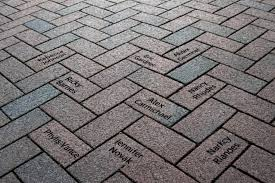
A physical installation overcomes these retention hurdles far better than a simple thank-you letter. An engraved brick campaign transforms a standard walkway or memorial wall into a deeply personal community archive. Donors become emotionally invested because they can actually visit the site and see their family name, a loved one’s memory, or a personal message etched into stone.
When donors know their contribution will be permanently etched into a community space, the incentive to give increases dramatically. By using custom engraved bricks, organizations can offer a tangible piece of history that naturally drives higher donation volumes and does the heavy lifting for your campaign.
How an Engraved Brick Fundraiser Works (Start to Finish)
At its core, a brick fundraiser transitions a community space into a profitable, donor-funded memorial. You sell personalized bricks to supporters, and the profits generated above the cost of manufacturing go directly toward your fundraising goal.
Unlike hosting a large gala event or buying bulk inventory for a product sale, brick campaigns demand very little upfront capital. You only order the bricks after your donors have paid for them. This entirely removes the financial risk and complex inventory management that typically plague community campaigns.
The process is straightforward and easy to manage when broken down into clear phases.
| Campaign Phase | Action Items | Purpose |
|---|---|---|
| 1. Planning | Define the project and calculate your financial goal. | Ensures the committee has a clear, measurable target. |
| 2. Organization | Assign specific roles (marketing, order processing). | Prevents burnout by dividing tasks among volunteers. |
| 3. Vendor Selection | Choose a laser engraving company with free tools. | Guarantees product durability and simplifies tracking. |
| 4. Marketing | Promote the campaign using digital tools and physical samples. | Drives donor awareness and secures immediate sales. |
| 5. Installation | Host an unveiling ceremony to showcase the bricks. | Celebrates the community and encourages future donations. |
Setting Financial Goals and Organizing Your Committee
The first step to a successful campaign is calculating the specific financial goal for your community project. Whether you are funding a new school playground, restoring a religious center, or building a veteran’s memorial, you need a hard number. Knowing exactly how much money you need allows you to set clear sales targets for your team.
Next, you need to form a dedicated committee. Do not attempt to run the entire campaign by yourself. Assign specific volunteers to handle distinct tasks like social media marketing, community outreach, and order processing.
Finally, partner with a vendor that makes your job easier. Look for a company that provides free order tracking tools and donor management software. These resources eliminate administrative strain and keep your committee organized from the first sale to the final installation.
Structuring Inclusive Pricing and Donation Tiers
To maximize your revenue, you need to structure your pricing to ensure the campaign is accessible to all demographics. Not every supporter has the same financial capacity. By creating multiple price points based on brick size, you accommodate different budgets.
Affordable baseline pricing tiers ensure inclusivity. A standard 4×8 brick priced reasonably allows families, students, and everyday community members to leave a permanent mark on a cause they care about. When people feel included, participation rates skyrocket.
You should also offer premium options to attract higher-tier sponsorships. An 8×8 brick naturally commands a higher donation price. You can increase this value further by allowing local businesses to engrave their corporate logos. Other premium add-ons include custom signatures or even children’s artwork, which provides a highly personalized product that wealthy donors and businesses are eager to buy.
Maximizing Profits Beyond the Main Installation
While your main walkway or memorial wall will bring in substantial funds, you can push your revenue much higher using “add-on” sales. This is a highly effective strategy that goes beyond the physical installation site and requires very little extra effort from your committee.
The most popular add-on is selling scaled-down replicas, often called “Mini Bricks.” These are exact duplicates of the donor’s original engraved brick. Supporters love buying these replicas to keep in their homes or offices, often using them as paperweights, bookends, or display pieces.
Selling replicas creates a deep emotional connection, especially for donors who might live out of state and cannot visit the actual installation site. The logistics are incredibly simple. These replicas can be shipped directly to the donors’ homes, complete with protective felt dots on the bottom to prevent scratching furniture.
By offering a Certificate of Authenticity alongside the replica, you elevate the perceived value of the donation. This simple upsell strategy routinely helps organizers exceed their baseline fundraising goals without needing to find a single new donor.
Ensuring Your Campaign Lasts a Lifetime
A primary pain point for any campaign organizer is the fear of long-term maintenance. You do not want to field complaints from donors five years from now because their family name has faded, chipped, or washed away from the memorial walkway. The durability of your installation is tied directly to the manufacturing method you choose.
Outdated methods, such as traditional sandblasting or routing, carve deep grooves into the masonry. These crevices trap dirt, ice, and water. When winter hits, the trapped water freezes and expands, causing the surface to crack and peel.
To ensure the community’s legacy is fully protected, you must insist on state-of-the-art patented laser engraving technology. Instead of carving into the material, high-powered lasers interact with the clay, turning the engraved area into a dark, glass-like substance. This creates a smooth surface that blocks dirt and moisture completely.
Laser engraving, combined with green technology manufacturing, allows for highly intricate details that survive harsh outdoor conditions for decades. Always look for vendors that build trust through a lifetime warranty. This guarantees you are making a safe, long-term investment that honors your donors perfectly.
Marketing the Campaign and Managing Logistics
Securing donor participation requires a mix of digital outreach and tangible proof. Start with simple marketing strategies like sharing social media stories about the specific project you are funding. Send out email newsletters detailing how buying a brick directly helps the community.
However, the most powerful marketing tool is a physical sample. People need to see and touch the product to truly understand its value. Bring a physical sample brick to local community events, PTA meetings, or religious services. When potential donors run their hands over the smooth, permanent lettering, the product easily sells itself.
To do this, look for risk-free vendor onboarding features. Specifically, find a vendor that allows you to request a free brick sample to show your committee before you commit to a contract. Keeping overhead costs near zero is essential. Choose partners that offer fast turnaround times, like 48-hour shipping on certain orders, along with free shipping options.
Once the bricks arrive and are placed in the ground, keep donors engaged by hosting a formal unveiling ceremony. Invite everyone who purchased a brick to come find their name. This event naturally encourages future, repeat donations from attendees who missed out on the first round and now want to be part of the legacy.
Conclusion
Engraved bricks are the ultimate low-risk, high-reward fundraising solution for community projects of any size. By replacing standard, transactional giving with permanent physical recognition, you directly solve the problem of donor fatigue.
Tiered pricing ensures that every community member can afford to participate, while offering mini replicas boosts your overall profits with minimal effort. Prioritizing laser-engraved products guarantees that your hard work results in a beautiful, maintenance-free landmark that lasts a lifetime.
By offering a tangible piece of history, the physical brick itself becomes the primary incentive. This takes the heavy pressure off your organizing committee and allows the project to sell itself. Take the first step today by requesting a free sample to see the lasting impact firsthand, and watch your community build a legacy together.